
Baccarat is famous for being one of the most straightforward table games in the casino, yet its third card rules often confuse new and seasoned players alike. While players don’t need to make decisions during play, understanding why and when a third card is dealt reveals the mechanics behind the game’s low house edge and optimal betting strategies.This comprehensive guide breaks down the Baccarat third card rules, how they affect the odds, and step-by-step examples to clarify every outcome.
What Is the Baccarat Third Card Rule?
The third card rule is a fixed set of mandatory instructions that determines whether the Player or Banker hand receives a third card.
Why the Third Card Rule Exists
Unlike Blackjack, where players decide whether to hit or stand based on preference, Baccarat operates on strict, predetermined guidelines. The third card rule ensures:
- Uniformity: Every hand plays out identically across all tables worldwide.
- Calculated House Edge: The structured drawing rules give the Banker hand a slight statistical advantage.
- Pacing: Hands resolve quickly without player hesitation or strategy delays.
How It Affects the Outcome of the Game
The third card rule dictates the final hand values, shifting probabilities slightly in favor of the Banker. Because the Banker’s decision to draw depends on the Player’s third card, the Banker acts with more information, resulting in a higher win frequency.
Is the Third Card Rule Automatic?
Yes. Neither the player nor the dealer has any say in whether a third card is drawn. The dealer evaluates the initial two-card totals and applies the rules automatically.
How Baccarat Hands Are Dealt
Understanding the dealing process helps clarify when the third card rule comes into play.
The Initial Two Cards
Every round begins with two two-card hands dealt from the shoe:
- Player Hand
- Banker Hand
Determining the Hand Total
Card values in Baccarat are calculated as follows:
- Cards 2–9: Face value
- 10, Jack, Queen, King: 0 points
- Ace: 1 point
The Drop-Ten Rule: If a hand total reaches double digits, the tens digit is dropped. For example, a becomes a total of 3.
When the Game Ends Without a Third Card
If either the Player or Banker is dealt a Natural 8 or 9 with their first two cards, the round ends immediately. No third cards are drawn for either side, and the higher total wins.
Player Third Card Rules
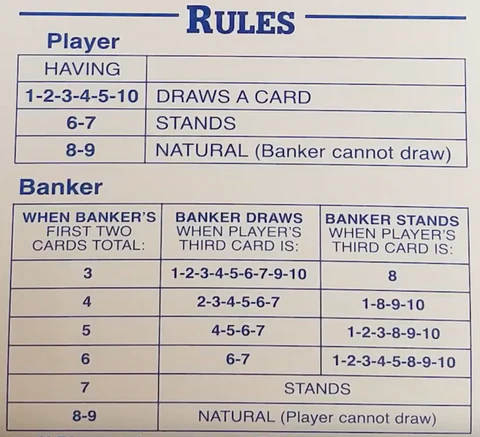
The Player hand always acts first. Its rules are remarkably straightforward because they depend entirely on the initial two-card total.
Player Stands on 6 or 7
If the Player’s initial two cards equal 6 or 7, the Player stands. The Banker hand then acts according to its own two-card rules.
Player Draws on 0–5
If the Player’s total is 0, 1, 2, 3, 4, or 5, the Player must draw a third card (unless the Banker has a Natural 8 or 9).
Banker Third Card Rules
The Banker’s drawing rules are more complex because they depend not only on the Banker’s current total, but also on whether the Player drew a third card and what specific card the Player received.
Banker Draws When the Total Is 0–2
-
If the Banker’s initial total is 0, 1, or 2, the Banker always draws a third card, regardless of the Player’s hand (unless the Player has a Natural 8 or 9).
When the Banker Stands on 7
-
If the Banker’s initial total is 7, the Banker always stands.
Banker Rules for Totals of 3–6
When the Banker holds a total between 3 and 6, the decision depends on the Player’s third card value:
- Banker Total = 3: Draws unless the Player’s 3rd card was an 8.
- Banker Total = 4: Draws if the Player’s 3rd card was 2, 3, 4, 5, 6, or 7.
- Banker Total = 5: Draws if the Player’s 3rd card was 4, 5, 6, or 7.
- Banker Total = 6: Draws only if the Player’s 3rd card was a 6 or 7.
Note: If the Player does not draw a third card (holds a 6 or 7), the Banker simply draws on 0–5 and stands on 6–7.
Baccarat Third Card Rule Chart
Use this reference table to see exactly when the Banker draws based on the Player’s third card.
Complete Banker Drawing Chart
Step-by-Step Third Card Examples
Example 1: Player Draws a Third Card
- Initial Deal: Player gets . Banker gets .
- Player Action: Total is 4, so Player draws. Player gets a 7. Player’s new total: .
- Banker Action: Banker has 5, and Player’s 3rd card was a 7. According to the chart, Banker draws. Banker gets a 3. Banker’s new total: .
- Outcome: Banker wins (8 vs. 1).
Example 2: Banker Draws a Third Card
- Initial Deal: Player gets . Banker gets .
- Player Action: Total is 7, so Player stands.
- Banker Action: Since Player stood, Banker acts on basic rules (draws on 0–5). Banker total is 4, so Banker draws. Banker receives a 4. Banker total: .
- Outcome: Banker wins (8 vs. 7).
Example 3: Natural Win Ends the Round
- Initial Deal: Player gets (Natural). Banker gets .
- Action: A Natural 9 triggers an immediate end to the hand. No third cards are dealt.
- Outcome: Player wins (9 vs. 6).
Example 4: Both Hands Stand
- Initial Deal: Player gets . Banker gets .
- Player Action: Total is 6, so Player stands.
- Banker Action: Player stood, and Banker holds a 7, so Banker stands.
- Outcome: Banker wins (7 vs. 6).
How the Third Card Rule Affects Banker and Player Bets
The conditional drawing rules directly shape the house edge and payout structure of Baccarat.
Why the Banker Bet Wins Slightly More Often
Because the Banker acts second and uses the Player’s third card to determine its drawing action, the Banker hand wins 45.86% of all hands (excluding ties), compared to the Player’s 44.62%.To offset this built-in advantage, casinos charge a 5% commission on winning Banker bets in traditional games.
The Relationship Between Drawing Rules and House Edge
Common Mistakes About the Third Card Rule
- Thinking Players Can Choose to Draw: Beginners often assume they can hit or stand based on gut feeling. The rules are strict and automated by the dealer.
- Confusing Baccarat With Blackjack: In Blackjack, reaching 21 is the goal and bust options exist. In Baccarat, hands cannot bust, and totals cycle from 0 to 9.
- Misreading the Banker Decision Chart: The Banker chart refers to the value of the Player’s 3rd card, not the Player’s new overall hand total.
Baccarat Variations and Third Card Rules
While the underlying third card rules remain consistent across games, different variants handle payouts and table setups differently:
- Punto Banco: The standard version found across North America, Australia, and online casinos. Uses fixed rules with dealer-controlled dealing.
- Mini Baccarat: Features lower stakes and faster gameplay on a smaller table. Uses identical drawing rules, but the dealer handles all cards face up.
- No Commission Baccarat: Eliminates the 5% Banker commission. To preserve house edge, winning Banker hands with a total of 6 typically pay 50% (1:2) instead of 1:1.
- Live Dealer Baccarat: Online games streamed in real time. Software automatically highlights third-card draws on the screen according to standard rules.
Frequently Asked Questions
Can players decide whether to draw?
No. All third-card draws are dictated strictly by the rules of the game.
Does the third card rule change between casinos?
No. Standard Baccarat rules for Player and Banker hits/stands are uniform worldwide.
Is the rule different in online Baccarat?
The rules are identical. In online versions, digital dealers or random number generators (RNG) apply the drawing logic automatically.
While the Banker third card chart may seem intricate at first glance, you don’t need to memorize it to play Baccarat effectively. Because all drawing decisions are automated by the dealer or software, your primary decision as a player is simply choosing which hand to bet on — with the statistical odds consistently favoring the Banker bet over the long run.
